 Best Slot Wins
BTC vs ETH vs USDT for Casino Deposits
Key Takeaways
- Bitcoin is the most universally accepted option but often the slowest to confirm, especially during network congestion
- Ethereum gas fees fluctuate independently of deposit size, which can disproportionately eat into smaller deposits
- Stablecoins like USDT remove price-volatility risk entirely, and confirm in seconds on fast networks like Tron
- Sending a stablecoin on the wrong network (e.g. ERC-20 vs TRC-20) can permanently lose the funds — always match the network, not just the coin
Almost every crypto casino we cover accepts a similar core lineup — BTC, ETH, USDT, and a handful of others — but the three don't behave the same way once you're actually depositing and withdrawing. Here's the real, practical difference.
Bitcoin: The Default, Not Always the Fastest
Bitcoin is the most universally accepted crypto across every casino we've reviewed, and for good reason — it's the asset most new crypto users already hold. The tradeoff is confirmation time: Bitcoin blocks land roughly every 10 minutes on average, and most platforms wait for several confirmations before crediting funds, so a deposit or withdrawal can take anywhere from a few minutes to closer to an hour depending on network congestion. Several of the casinos we cover explicitly flag Bitcoin as the slowest of their supported coins for exactly this reason.
Ethereum: Flexible, but Gas Fees Bite on Smaller Deposits
Ethereum blocks land roughly every 12 seconds — faster than Bitcoin's — but network gas fees fluctuate independently of the deposit amount, spiking during busy periods regardless of how much you're actually sending. That means a small deposit can lose a disproportionate chunk of its value to network fees. It's a reasonable choice if you're already holding ETH, but rarely the cheapest option for a modest deposit specifically.
USDT and Other Stablecoins: Built for This Exact Use Case
Stablecoins solve the one problem BTC and ETH share: price volatility between the moment you deposit and the moment you play. A $100 Bitcoin deposit can genuinely be worth $95 or $105 by the time you're ready to withdraw, purely from market movement having nothing to do with how you played. USDT (and similar stablecoins) removes that variable entirely, and on faster networks the confirmation gap gets dramatically smaller too.
Confirmation Times, Side by Side
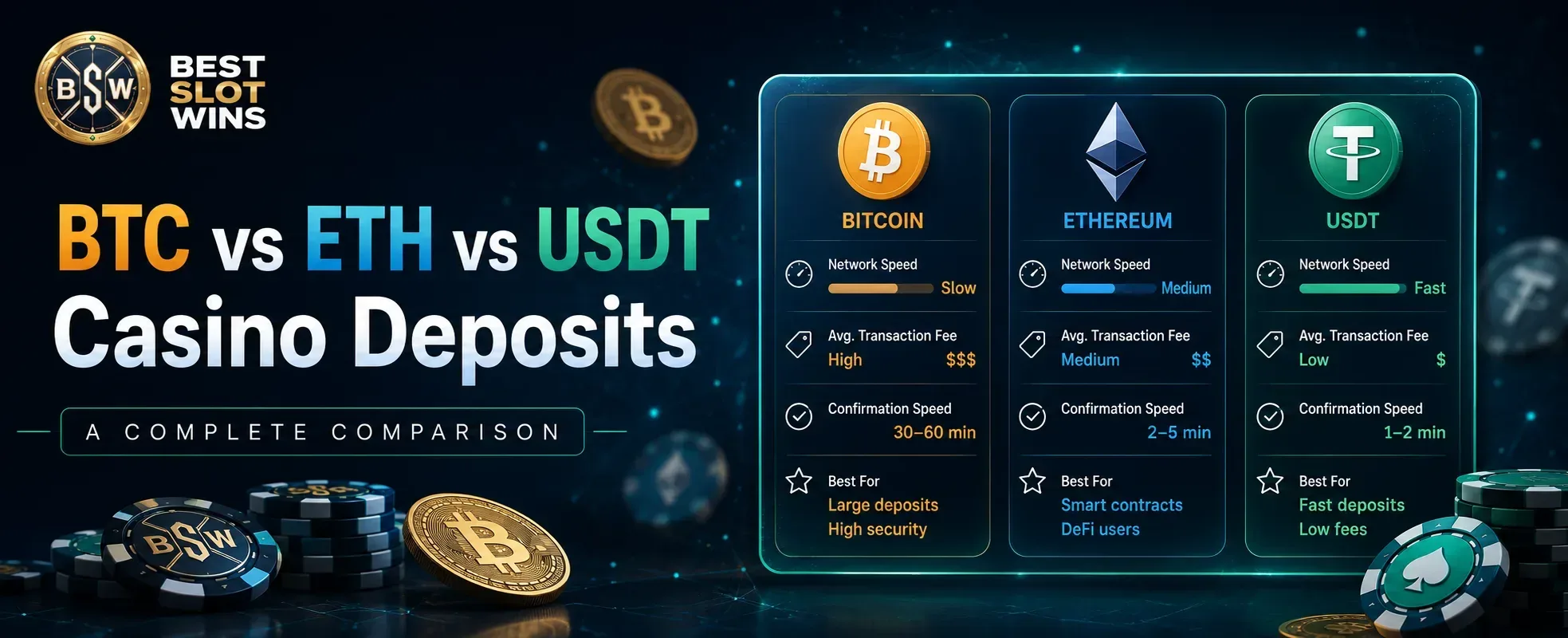
The network a stablecoin rides on matters as much as the coin itself. Independent comparisons of the major networks put average block times at roughly 10 minutes for Bitcoin, about 12 seconds for Ethereum, and around 3 seconds for Tron — which is why USDT sent over Tron (TRC-20) is usually the fastest practical deposit option available anywhere in this lineup:
- Bitcoin: ~10 minutes per block; casinos typically wait for multiple confirmations, so real-world crediting often runs 10-60 minutes.
- Ethereum (ETH or USDT/ERC-20): ~12 seconds per block; usually credited within a few minutes, but gas costs vary with network congestion.
- Tron (USDT/TRC-20): ~3 seconds per block; transfers are typically included in the very next block, with full finality in under a minute and minimal fees.
The Network Matters More Than the Coin — And Getting It Wrong Is Costly
One genuinely important practical point: USDT and other stablecoins aren't a single asset on a single chain — the same stablecoin can exist as an ERC-20 token on Ethereum, a TRC-20 token on Tron, or an SPL token on Solana, and these versions are not interchangeable at the address level. Sending TRC-20 USDT to an address that only expects ERC-20 (or vice versa) can permanently lose the funds — there's no dispute process that reverses a transaction sent to the wrong network. Always match the exact network your casino's deposit page specifies, not just the coin symbol, especially when copying an address from a wallet that supports the same coin across multiple chains.
Withdrawal Speed Isn't Just About the Blockchain
It's worth separating two things that get conflated: how fast a network confirms a transaction, and how fast a casino actually processes a withdrawal request in the first place. A Tron-speed stablecoin transfer doesn't help if the operator queues withdrawals for manual review before it even broadcasts the transaction — which is common practice, especially for larger amounts. Our own reviews test and list each operator's real, observed withdrawal speed rather than assuming it purely from the network — in our testing, that operator-side processing time varies more between casinos than the underlying blockchain does.
What We'd Actually Recommend
- For your bankroll's stability: a stablecoin like USDT, specifically on a fast network like Tron or Solana — it removes price volatility from the equation entirely, which matters more the longer you plan to keep funds on-platform.
- For speed specifically: check which coin and network a given casino processes fastest rather than assuming — see our comparison tool for each operator's real tested withdrawal speed, which varies more by casino than by coin in some cases.
- For simplicity: Bitcoin remains the path of least resistance if you already hold it and don't want to convert — just budget extra time for withdrawals specifically, and double-check the deposit network either way.
Whichever you pick, the network fee itself is usually the smaller factor — most operators we cover don't charge a platform fee on top of it, so the real decision comes down to speed, volatility, and getting the network right, not cost.
Frequently Asked Questions
No — sending a stablecoin on the wrong network (e.g. an ERC-20 address when the casino expects TRC-20) can permanently lose the funds. Always match the exact network the casino's deposit address specifies, not just the coin.
Bitcoin's block time averages around 10 minutes, and most platforms wait for multiple confirmations before crediting funds. Faster networks like Tron, which average roughly 3-second blocks, confirm stablecoin transfers in seconds by comparison.
Most of the operators we've tested don't add a platform fee on top of the underlying network fee — check our comparison tool for each casino's actual tested numbers rather than assuming.
A stablecoin like USDT removes price volatility entirely, since it's pegged 1:1 to the US dollar rather than fluctuating with the market the way Bitcoin or Ethereum does.
Looking for a place to play? Here's our current top-rated lineup, bonuses included.