 Best Slot Wins
What Is Provably Fair Gambling? A Complete Guide
Key Takeaways
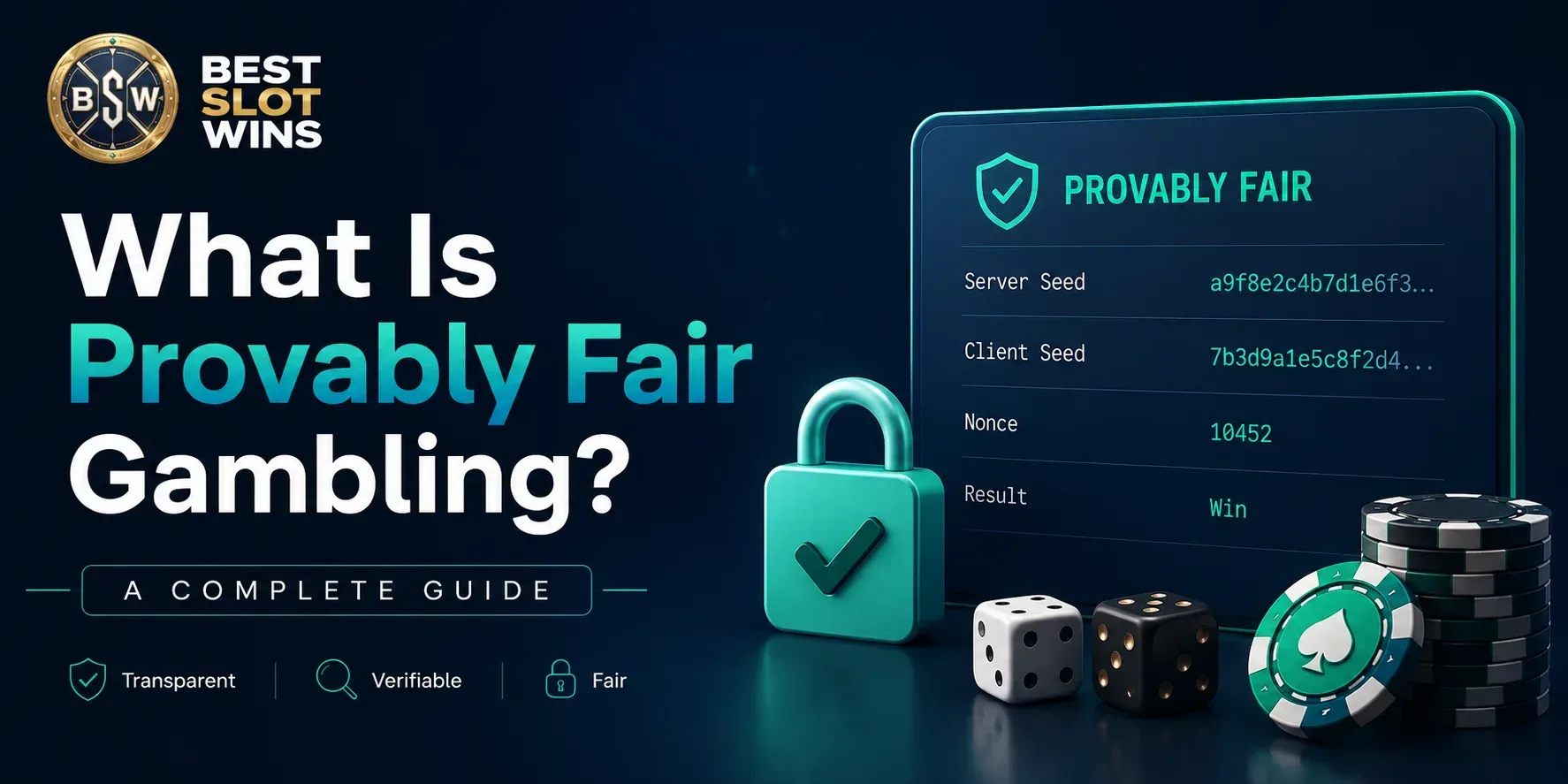
- Provably fair uses a hashed server seed, a client seed, and a nonce so you can verify a result wasn't altered after the fact
- You need the revealed server seed, your client seed, and the nonce from a past round to actually check it yourself — the whole process takes under a minute
- It typically only covers an operator's in-house Originals — not the wider slot and live-dealer catalog, which runs on the game studio's own certified RNG instead
- Provably fair and “licensed” are two separate guarantees — a technical one and a legal one — and checking one doesn't tell you about the other
If you've spent any time reading crypto casino reviews — including ours — you've run into the phrase “provably fair,” usually dropped in as a selling point without much explanation. Here's what it actually means, how the math behind it works, and — just as importantly — what it doesn't cover.
The Problem It Solves
Every casino game has a random outcome under the hood, and traditionally you just have to trust the operator that the randomness wasn't rigged in their favor. Provably fair systems replace that trust with math: instead of asking you to believe the casino, they give you a way to independently verify, after the fact, that a specific spin, roll, or hand couldn't have been altered once it was underway.
How It Actually Works
The mechanism is the same across almost every provably fair implementation, whether it's Stake Originals, Duel's in-house games, or Shuffle's Originals lineup:
- Server seed: before you place a bet, the casino generates a random string (the server seed) and shows you its cryptographic hash — a scrambled fingerprint that proves the seed already existed without revealing what it actually is.
- Client seed: your browser or account generates its own random string, which combines with the server seed to help determine the outcome. Some platforms let you set this yourself.
- Nonce: a counter that increments with every bet, so the same seed pair never produces the same result twice in a row.
- The reveal: after the round, the casino publishes the original server seed. You (or a third-party checker tool) can hash it yourself and confirm it matches the hash shown before the bet — proof the outcome wasn't quietly changed after you placed it.
The hash step is the whole point: publishing the raw server seed upfront would let a sharp player predict outcomes, but publishing only its hash lets you confirm honesty retroactively without giving anything away in advance.
A Worked Example
Say a Dice game shows odds of rolling under 50. Before you place a single bet, the casino has already committed to a server seed and shown you its hash — a fixed-length string produced by running the seed through a one-way cryptographic hash function like SHA-256. You play ten rounds with your client seed and a nonce that ticks up from 1 to 10. Once you're done with that seed pair, the casino reveals the raw server seed. Run it through the same hash function yourself and it should reproduce the exact hash you were shown before your first bet — change even a single character of the seed and the hash comes out completely different, so a match is strong evidence the seed wasn't swapped mid-session to shift the odds against you. Feed the revealed seed, your client seed, and each nonce into the algorithm the casino publishes, and you should get back the exact roll values you saw in the game. Independent explainers of the mechanism walk through the same process in more technical detail if you want to see it applied to other game types.
How to Actually Verify a Result
Most platforms that implement this properly have a built-in seed-checking tool, usually linked from the game itself or your account settings. The process is the same everywhere:
- Find the seed-checking tool — usually under your account's “Fairness” or “Provably Fair” settings, or linked directly from the game.
- Copy the revealed server seed, your client seed, and the nonce from a round you've already played.
- Paste them into the checker — either the casino's own tool or a free third-party SHA-256 verifier — and let it recompute the result.
- Compare the recomputed result to what you actually saw in-game. A match confirms the round wasn't altered after the fact.
It's worth actually doing this once, on a game you've played, rather than taking the feature on faith the same way you'd take an un-provable RNG on faith. The check itself is free and takes under a minute — that's the entire point of the system.
What Provably Fair Doesn't Cover
This is the part most casino marketing conveniently skips. Provably fair verification only applies to games built on the mechanism in the first place — typically an operator's own in-house Originals (Dice, Mines, Plinko, Crash, and similar). The much larger slot and live-dealer catalog most casinos also offer runs on the game studio's own RNG (Pragmatic Play, Evolution, NetEnt, and so on) — fairness there depends on independent testing labs like eCOGRA, iTech Labs, or GLI certifying the studio's RNG, a completely different (and non-player-verifiable) trust model.
So “provably fair” as a headline claim doesn't mean the entire site is player-verifiable — it usually means a specific, often small, category of games is. Worth checking exactly which titles are covered before assuming the label applies platform-wide, and worth comparing which operators lean hardest into their own Originals catalog if that's what you actually care about.
Provably Fair Isn't the Same as Licensed
It's easy to conflate the two, but they answer different questions. A gambling license — from a regulator like Curaçao's licensing authority, or a stricter body like the UK Gambling Commission or the Malta Gaming Authority — is a legal statement: an operator has met a jurisdiction's requirements around funds handling, anti-money-laundering checks, and dispute resolution. Provably fair is a technical statement: a specific game's outcome can be mathematically verified after the fact. A casino can have one without the other, and having both is the actual bar worth clearing — check both a casino's licensing (covered in how we review) and which of its games are provably fair before assuming either one alone means the whole platform is trustworthy.
Why It Matters, Even If You Never Run the Check
Most players never actually paste a seed into a checker — and that's fine, the mechanism doesn't require you to for it to do its job. What matters is that the option exists at all: a platform that publishes hashes upfront and reveals seeds after the fact has nothing to hide by design, which is a meaningfully different posture than a black-box RNG you're simply asked to trust. If you do want to see it in action, Stake and Duel both surface their fairness tools directly in the game UI, which is the easiest way to try a real verification for yourself.
Frequently Asked Questions
Yes — the randomness comes from combining a server seed you can't predict with a client seed you control, so neither side can unilaterally choose the outcome. What provably fair adds isn't more randomness, it's proof that the seed wasn't swapped after you placed your bet.
No. They're separate things: provably fair is a technical guarantee about a specific game's outcome, while a license is a legal guarantee about how an operator is regulated. A casino can have either without the other — check both.
Typically an operator's own in-house Originals — games like Dice, Mines, Plinko, and Crash. Licensed slots and live-dealer tables from third-party studios run on the studio's own certified RNG instead, which isn't player-verifiable the same way.
No — most platforms have a built-in checker in your account settings, and free third-party SHA-256 verifiers work too. You just need the revealed server seed, your client seed, and the nonce from the round you're checking.
Thinking about trying it out? These are the crypto casinos we'd actually recommend.