 Best Slot Wins
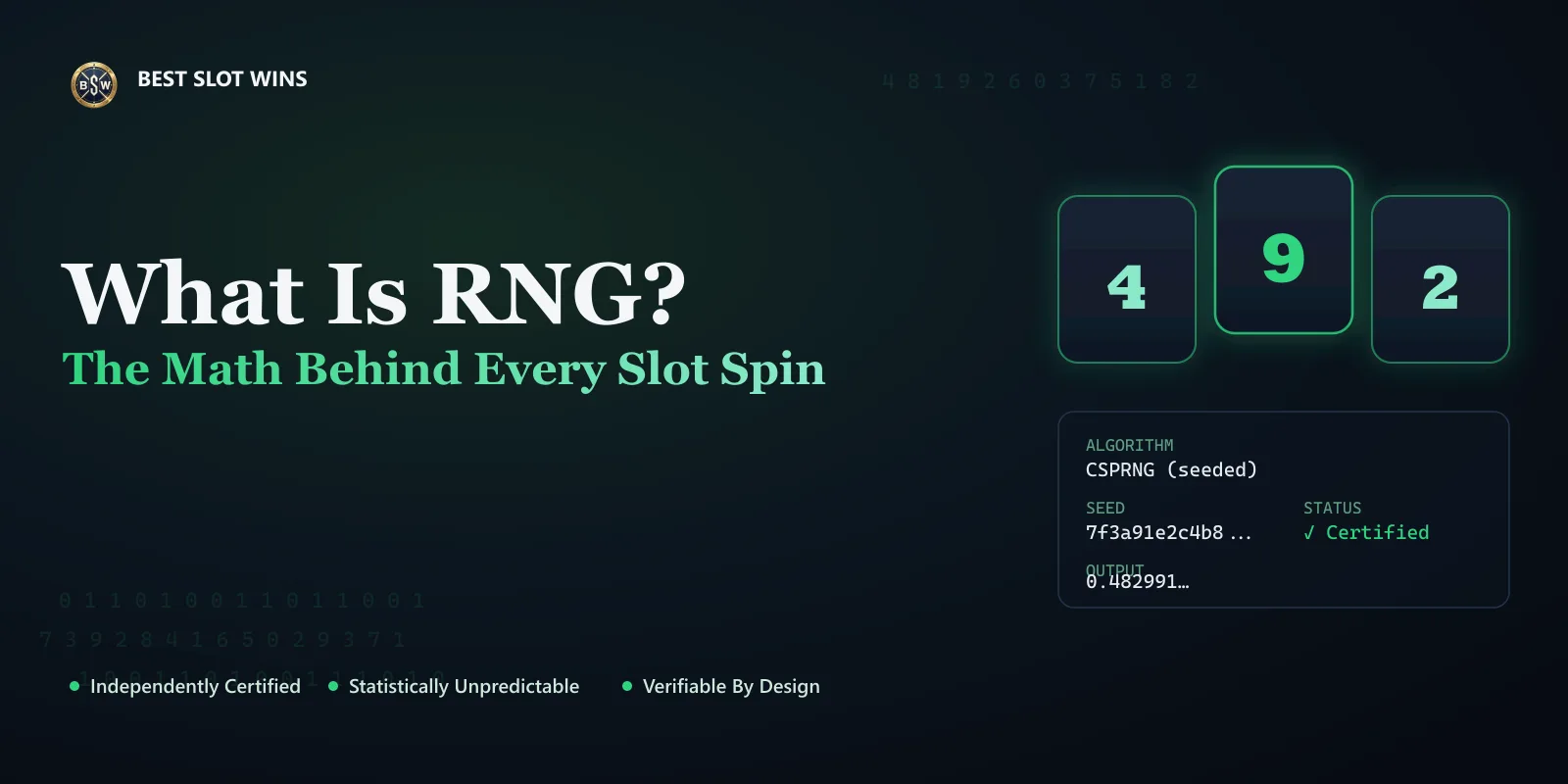
What Is RNG? The Math Behind Every Slot Spin
Key Takeaways
- RNG is the algorithm that decides every spin's outcome — not the casino, not "luck," a fixed piece of code
- Nearly every online slot uses a cryptographically secured PRNG, not physically-sourced true randomness
- RNG fairness and RTP are two different things, tested separately by independent labs like GLI, iTech Labs, and eCOGRA
- Every spin is statistically independent — there's no such thing as a slot being "due" for a win
- Crypto casino "Originals" games extend RNG with provably fair verification you can check yourself
Every online slot spin, every dice roll, every shuffled deck at a crypto casino comes down to the same three letters: RNG. It's printed on payout tables, buried in terms and conditions, and name-dropped in casino marketing — and it's one of the least explained parts of how these games actually work. Here's what RNG really is, how it works, and how independent labs check that it's doing its job.
What RNG Actually Means
RNG stands for random number generator — the software (or, less commonly, hardware) responsible for producing the random values that decide a game's outcome. Every time you spin a slot reel, the RNG generates a random number, and the game's own logic maps that number onto a result: which symbols land, whether a bonus round triggers, how much — if anything — you win. Wikipedia's entry on random number generation covers the general concept in more depth; this article focuses on how it applies specifically to casino games.
PRNG vs. True Random Number Generators
Not all randomness is generated the same way. A true random number generator (TRNG), sometimes called a hardware random number generator, pulls randomness from a genuinely unpredictable physical source — atmospheric noise, radioactive decay, tiny fluctuations in electrical current. A pseudorandom number generator (PRNG), by contrast, is a deterministic algorithm: give it the same starting value — its seed — and it will always produce the exact same sequence of numbers.
That might sound like the opposite of what you'd want from a fair casino game, but it's actually why PRNGs are the industry standard. A well-built PRNG's output is statistically indistinguishable from true randomness over a real game session, it needs no special hardware, and — crucially for regulators — its determinism means an auditor can seed it with a known value and verify the exact sequence of outputs it produces, which isn't possible with a genuinely physical random source. Virtually every online slot you'll play, including the ones at Stake, Rainbet, and Shuffle, runs on a PRNG.
The Algorithms Behind the Curtain
The specific algorithm matters. One of the most widely used general-purpose PRNGs in computing is the Mersenne Twister, prized for an enormously long period before it repeats and excellent statistical distribution. It's a great choice for simulations and video games — but it has a well-documented weakness for gambling specifically: because it's fully deterministic and its internal state can be reconstructed from a relatively small number of observed outputs, someone who sees enough of a Mersenne Twister's results can, in principle, predict its future output. Security researchers have documented real cases of exactly this kind of attack being used against slot machines running weak or outdated PRNGs — see Wikipedia's entry on random number generator attacks for how these attacks generally work.
That's why regulated casino RNGs use cryptographically secure pseudorandom number generators (CSPRNGs) — a stricter category specifically designed to resist prediction, even by an attacker who has already seen a long run of previous outputs. "Random enough to look natural" and "random enough to be un-gameable by a motivated attacker" are genuinely different engineering problems, and licensed gambling software has to clear the harder one.
What the RNG Actually Decides
An RNG doesn't know what a slot symbol is. What it produces is just a number, or a stream of numbers, within some range. The game's own logic — built by the software studio, not the casino — then maps that number onto an outcome using a predetermined table: this range of values means "cherry, cherry, bar"; this narrower range triggers the bonus round; and so on. Because that mapping is fixed and the RNG has no memory of anything it's produced before, two things follow directly:
- Every spin is statistically independent. The RNG doesn't "remember" the last ten spins, so nothing about them changes the odds of the next one.
- There's no such thing as a machine being "due" for a win, or running hot or cold. That's the gambler's fallacy — a documented cognitive bias, not a property of how the software works. A slot that hasn't paid out in 500 spins has exactly the same odds on spin 501 as it did on spin 1.
RNG and RTP Are Not the Same Thing
This is the single most common mix-up in how players talk about slots. RNG describes how the numbers are generated — is the process fair and unpredictable? RTP, or return to player, describes something completely different: the percentage of all wagered money a game is mathematically designed to pay back over a very large number of spins. A game can have a perfectly fair, uncompromised RNG and still carry a low RTP or a high one — the RNG doesn't set that number, the game's paytable design does. A 96% RTP slot and a 92% RTP slot can both run on an identical, equally fair RNG; what differs is how the studio weighted the outcomes.
Most slots at the casinos we review run on third-party engines built by dedicated studios rather than the casino itself — Pragmatic Play, Evolution, and Hacksaw Gaming are common names across Stake, Rainbet, Winna, and Razed, among others. Those studios are the ones whose RNG and RTP actually get tested — not the casino brand hosting the game.
How RNGs Actually Get Certified
Because "trust us, it's random" isn't good enough for a regulated industry, licensed operators are required to have their games' RNGs tested by independent labs — organizations like Gaming Laboratories International (GLI), iTech Labs, and eCOGRA. These labs run games through large batteries of statistical randomness tests and, separately, confirm that a game's actual long-run payout behavior matches its publicly stated RTP. Certification isn't a one-time stamp, either — reputable labs re-test periodically, since a studio pushing an update to a game's logic could, intentionally or not, change its behavior. When a casino review checks a casino's licensing — including our own review methodology — RNG certification is part of what that check actually verifies.
Provably Fair: RNG You Can Verify Yourself
Crypto casinos added a genuinely new option on top of all this: provably fair systems, used by in-house game collections like Stake Originals and BC.Game's BC Originals. Instead of asking you to trust a certification report you'll never read, a provably fair game lets you personally verify, after the fact, that a specific spin's result wasn't altered once it was underway — using the same cryptographic hashing principles that back the RNG's own seed. We cover exactly how that verification works, step by step, in What Is Provably Fair Gambling? — the natural next read if this article has you wanting to check a result yourself instead of just trusting the audit.
The Short Version
RNG is the algorithm deciding what happens on every spin. Reputable casinos use cryptographically hardened PRNGs, not just statistically-good ones, specifically because slots are a documented target for prediction attacks. RNG fairness and RTP are tested together but are mathematically separate properties — one isn't a marker of the other. And nothing about a "hot" or "cold" machine is real; every spin starts from zero, independent of everything before it.
Frequently Asked Questions
It's pseudorandom, not physically random — but a properly certified, cryptographically secure PRNG is statistically indistinguishable from true randomness for practical purposes, which is exactly what independent labs test for.
Not without breaking licensing terms and certification. A licensed operator's RNG is tested and periodically re-tested by an independent lab specifically to catch this. An uncertified or unlicensed site is a different story, which is why checking licensing is step one before checking anything else.
Indirectly. The RNG itself doesn't set your odds — the game's RTP and volatility settings do — but it guarantees the game isn't secretly favoring the house beyond what the published RTP already accounts for.
RNG is the general mechanism every regulated casino game uses. Provably fair is a specific, additional layer some crypto casino games add on top of it, letting a player independently verify an individual result rather than relying entirely on third-party certification.
Before you go — these are the bonus codes worth knowing about right now.